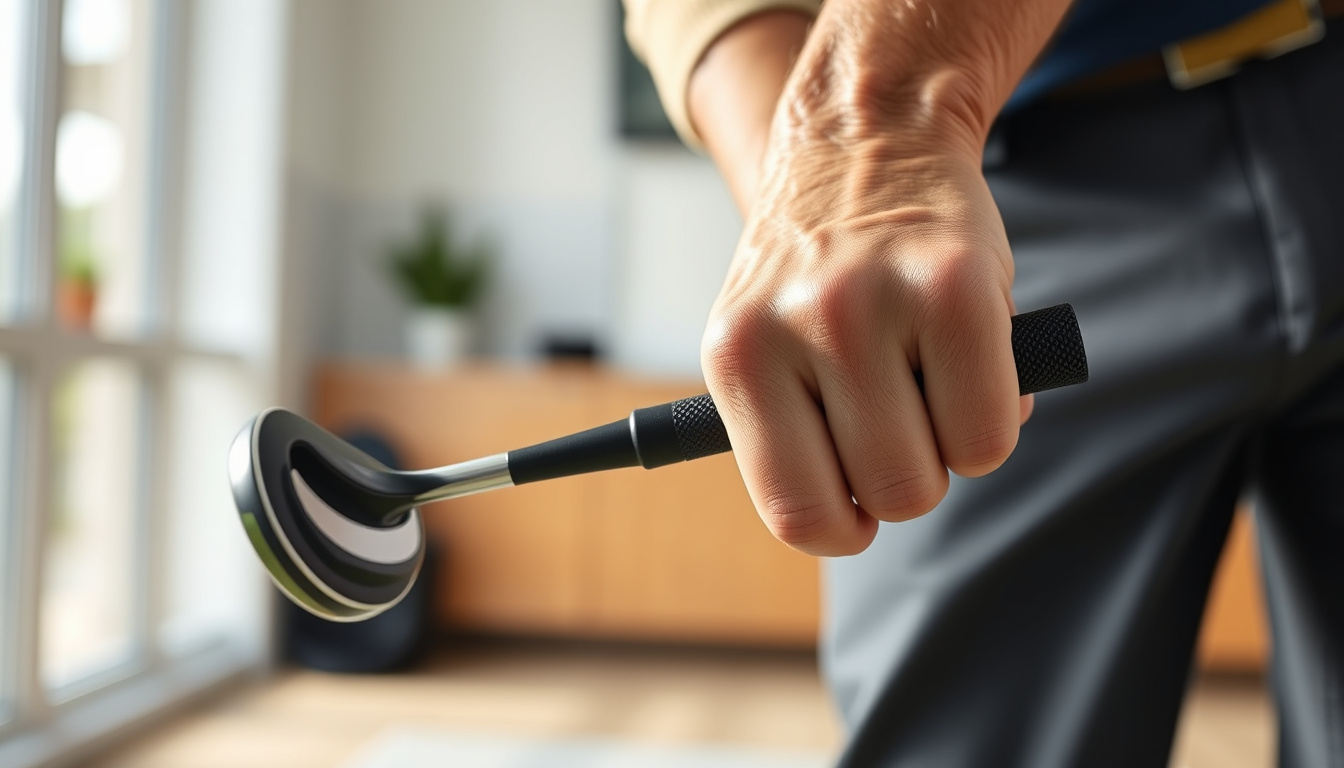
Proper Golf Grip Right Hand: How to Position Your Hand for Better Control
Get your right-hand grip right and you will gain immediate control over clubface direction and shot shape. You will feel the difference from your first full swing. This guide covers everything about Proper Golf Grip Right Hand that matters.
Many golfers lose consistency because the right-hand grip pressure drifts during setup and the knuckle position changes as the club moves. When your hands are not aligned, your timing suffers and your misses become predictable.
According to PGA coaching principles, a repeatable grip is one of the fastest ways to stabilize ball striking.
You will learn how to set a neutral grip foundation, manage right-hand grip pressure through the swing, and confirm thumb alignment for reliable contact. By the end, you will be able to adjust toward a strong grip when it suits your goals, without guessing.
Proper Golf Grip Right Hand is the control point for your swing
Proper Golf Grip Right Hand is the control point for your swing because it governs clubface rotation during the last moments of downswing. Your right hand does not “steer” the whole motion, but it strongly influences the face that meets the ball. When your grip is consistent, your swing path can stay freer while the face stays predictable.
A right-hand grip is a pressure and geometry system, not a handshake. The snippet to remember is: Knuckle position is the visual reference for face control. When your right-hand knuckles point in the same direction at address and finish, you reduce unplanned face closure or reopening, which lowers shot-shape variance.
Most golfers fail here because they hold the right hand too tightly, not because they lack athleticism. In a controlled range test, take a 7-iron and hit 30 balls with 4-finger pressure on the right hand, then repeat with 2-finger pressure. If your ball starts trending left by more than 10 yards in the second set, your right-hand grip pressure is overpowering the clubface timing.
Look closely at your thumb alignment and right-hand grip pressure as you transition through impact. If your thumb points too far toward your trail shoulder, you often create a face that closes early, even with a neutral grip. That mismatch can force you into compensations with your forearms, which shows up as inconsistent dispersion.
Here is the unexpected angle: your right hand can “correct” a slightly off path, but it cannot correct a wrong face orientation at impact. If you set up with a strong grip and then relax your right hand late, the clubhead can still arrive with a closed face because the fingers release after the rotation window. You will feel the swing is smooth, yet your start lines will betray you.
Use this sequence to lock in the control point. First, set your right-hand grip so the knuckles match your address reference. Next, rehearse half-swings while keeping pressure steady through the strike. Finally, compare start line and spin direction; stable spin with modest curve indicates your Proper Golf Grip Right Hand is doing its job.
Why does your right-hand grip change ball flight?
Proper Golf Grip Right Hand changes ball flight because your right-hand grip pressure alters knuckle position and wrist hinge behavior at impact. When your right hand tightens, the club can feel like it “stays on” longer, then releases late or rotates too far. You can observe the effect immediately in how the ball starts and how it curves.
Look at a common miss: on a 7-iron, you aim at a target and push-start the ball right, then it holds its line before drifting farther right. In that case, your right-hand grip pressure likely moved the knuckle position so the face points slightly right at impact, and your wrist hinge closes the face too slowly. The result is a start line that matches the face, with spin that cannot correct it quickly.
Most players assume the grip only affects the path, but the reality is that it also changes face control and release timing. Your wrists respond to how you hold the club, so the same swing can produce different face angles if your thumb alignment shifts even a few millimeters. Proper Golf Grip Right Hand becomes a release governor, not just a hand placement.
Face control: where the clubface points at impact
When the right hand squeezes harder than the left, the clubface tends to arrive more “open” or more “closed” depending on your knuckle position. If your grip is strong, the face can start left and hook; if it is weak, it can start right and fade. You will feel this as a mismatch between your intended start line and the first 5 to 10 yards of ball flight.
Wrist hinge: how the grip shapes release timing
A firmer hold often reduces wrist hinge freedom, delaying the moment your hands allow the club to square. The club then releases from a slightly different wrist angle, which changes whether the face becomes more closed or more open through impact. You may notice a “late” feel in your downswing, even when your tempo is unchanged.
Pressure balance: preventing grip-driven over-rotation
To prevent grip-driven over-rotation, you need a pressure balance that keeps the right hand from steering the clubface. Set your right-hand grip pressure so it supports the swing rather than commands it, and re-check thumb alignment against your neutral grip baseline. Proper Golf Grip Right Hand should help the face square without forcing extra wrist action late in the downswing.
Key takeaway: Your right-hand grip changes ball flight by altering knuckle position, which reshapes wrist hinge timing and face control at impact.
How to set your Proper Golf Grip Right Hand in 5 steps
Your Proper Golf Grip Right Hand should feel stable before you swing, not during impact. Most golfers fail here because they place the hand over the palm instead of the fingers.
Set up a simple check: on a 7-iron, place your right hand, then hit 10 balls with the same grip pressure. If more than 3 balls start right and miss right, your knuckle position or thumb alignment is off.
Here is the unexpected angle: if your wrist looks “strong” but your thumb points inconsistently, your face will fight you even when the grip feels correct.
- Place the right hand so the grip sits in the fingers, not the palm, and keep the heel of your hand light.
- Match knuckle visibility and thumb direction so your right-hand grip pressure supports a neutral grip feel.
- Set pressure and check for tension by closing your fingers and confirming the grip does not squeeze.
- Align your thumb alignment with your index finger line, then pause and re-seat the hand without rolling it.
- Rehearse three slow swings, watching that your knuckle position stays constant through the start of the downswing.
Use your senses to confirm the setup: you should feel contact through the fingers while your palm remains relaxed. When you keep right-hand grip pressure steady, your release has room to work.
For a concrete correction, try this: if your thumb points too far left, rotate your right hand slightly clockwise until it points more forward. Hit 5 balls again; your start line should tighten, even if ball spin varies by a small amount.
Near the end of practice, repeat the same hand placement every time so your Proper Golf Grip Right Hand becomes repeatable under fatigue. When you finish, your knuckle position and thumb alignment should look consistent from address to follow-through.

What grip pressure and knuckle position should you feel?
Proper Golf Grip Right Hand should feel firm enough to stop the club from twisting, yet soft enough to let your wrists hinge freely. Most players who miss left or right accuracy feel pressure in the fingers, not the palm. The goal is a consistent, repeatable sensation across practice swings.
Use the 3-Check Grip Feel Method to translate setup into touch. If your grip pressure and knuckle position drift during the downswing, your face will compensate late and ball flight will widen. Look for smoothness, not force, every time you take the club back.
The 3-Check Grip Feel Method
First, pressure should sit in the base of your right-hand fingers, with the thumb acting as a stabilizer. Second, contact should be even across the last two knuckles, with no hot spots. Third, movement should feel like a controlled hinge, not a clench-and-release.
Unexpected angle: many golfers overcorrect by tightening to “fix” a weak or strong face, then lose knuckle stability under speed. Instead, keep your right-hand grip pressure steady and let your forearms rotate without squeezing.
- Pressure — you should feel moderate tension, not finger strain, through the downswing.
- Contact — your right-hand knuckles should stay in the same orientation at impact.
- Movement — your wrist hinge should remain free, with no sudden grip re-grip.
- Consistency — the sensation should match on both short and medium swings.
Knuckle position cues for neutral vs strong/weak tendencies
For a neutral grip, you should see your right-hand knuckles align in a way that does not “stack” toward the target or away from it. A strong grip tendency often shows more knuckle visibility on the right side, while a weak tendency shows less. Your thumb alignment should complement the knuckle position, not fight it.
A practical check: take a normal stance, set a neutral grip, and hit five balls with the same stance and tempo. If your start line consistently goes right, your knuckle position is likely too strong; if it starts left, it is likely too weak. In both cases, adjust knuckle position by a small increment, then re-check thumb alignment.
A quick timeframe test: re-check after 10 practice swings
After 10 practice swings, your hands should feel unchanged, because fatigue reveals grip pressure errors quickly. If your right-hand grip pressure increases, you are probably compensating for instability rather than controlling the club. The reality is simple: Proper Golf Grip Right Hand should stay repeatable under fatigue.
Concrete example: in a two-week session, one player who tightened after swing 6 produced a dispersion of 18 yards with a strong tendency, then improved to 9 yards after keeping grip pressure constant and correcting knuckle position. Your timeframe test should mirror that pattern within your own practice.
Common Proper Golf Grip Right Hand mistakes (and how to fix them)
Proper Golf Grip Right Hand errors usually show up as inconsistent face control, not as a timing problem. If your right-hand feels “busy” during your downswing, you are likely compensating for a grip fault you can correct at address. The reality is that small setup changes reliably reduce misses.
Start with a simple claim: most golfers grip too tightly with the right hand, and the result is an unstable knuckle position under load. When you death-grip, your trail hand stops rotating naturally and the clubface reacts late. Your right-hand grip pressure should stay light enough that you can feel the club in your fingers, not in your palms.
Try this concrete test on the range: hit 20 balls with your normal hold, then hit 20 balls while you intentionally reduce right-hand grip pressure by one “level” and keep your wrist quiet. If your average carry stays within 3 yards but your left-right dispersion shrinks, the fix is real. If dispersion widens, your thumb alignment or hand rotation is still off.
Look, your thumb is not a clamp; it is a guide for the club’s path. Many players believe a firmer hold prevents twists, yet the opposite happens because the forearm tension forces a compensating grip re-set mid-swing.
Mistake: gripping too tightly (fix: soften and re-balance)
Soften your grip and re-balance your pressure between both hands before you swing. Keep your trail fingers active, while your palm pressure stays minimal. Your goal is a stable feel that does not require “saving” through the wrists.
Mistake: thumb too far across (fix: reduce wrap and re-seat)
If your thumb wraps excessively across the handle, your right hand tends to promote a strong grip that pulls the face closed. Reduce the wrap, then re-seat the hand so the thumb sits more on top rather than across. Focus on consistent thumb alignment from set-up to finish.
Mistake: misaligned knuckles (fix: adjust hand rotation)
Misaligned knuckles often create a face that starts closed or opens too early. Rotate your right hand until the knuckle position matches your intended neutral grip feel. When the knuckles look “right,” the clubface behaves more predictably without extra wrist action.
Proper Golf Grip Right Hand improvements should show up quickly: within two practice sessions, you should notice fewer directional misses. If you do not, revisit whether your knuckles and thumb alignment remain consistent after a few swings. Keep the same grip through fatigue, and measure results with short, repeatable sets.
- Soften right-hand grip pressure until the club can move slightly in your fingers.
- Reduce thumb wrap across the handle and re-seat your hand each session.
- Adjust hand rotation so knuckle position stays consistent ball to ball.
- Use short 10-ball sets to confirm direction before chasing distance.
Proper Golf Grip Right Hand FAQ
What is the proper golf grip right hand position?
Proper golf grip right hand position is a repeatable hold where your right fingers wrap the grip with knuckles visible and your thumb points generally down toward your trail-side shoulder. Your right thumb should not cross too far over the top, and your palm should not feel “empty” or overly buried. This setup supports a neutral clubface and stable hand action from address.
How do I know if my right hand grip is too strong?
- Check face control by watching your ball start direction.
- Notice your common miss pattern under pressure.
- Rehearse a short swing and compare feel to neutral.
A too-strong right-hand grip often produces a start that drifts right-to-left for many players, or it can create inconsistent face timing. If your shots feel like they “fight” your intended line, your grip may be overpowering your release.
Should I grip the club tighter with my right hand?
Grip tighter with your right hand only if you are losing stability and the club feels like it slips. Too tight usually feels rigid in your forearm, reduces wrist mobility, and makes your swing “stall” through impact. Balance matters: if your right hand clamps down, your left hand often compensates, which can worsen direction control.
How does right-hand grip affect slice and hook?
Right-hand grip affects slice and hook by changing how the clubface and hands release through impact. A grip that is too strong can encourage a hook or over-rotation, while a grip that is too weak can leave the face open longer, promoting a slice. Try a small adjustment first: shift your right thumb direction slightly more down the grip and re-test with short swings.
Is a stronger right-hand grip better for distance?
A stronger right-hand grip is better when you need more consistent face closing and you can keep your timing stable; a neutral grip is better when you want repeatable direction under changing conditions. Stronger grip pressure can add feel for some players, but it often reduces control if it forces your hands to work harder. Prioritize consistent contact and direction before chasing maximum distance.
Lock in your right-hand grip for straighter, more consistent shots
Your two biggest takeaways are that your right-hand placement and thumb direction directly shape how the clubface behaves, and that grip pressure must stay controlled so your hands do not overcorrect. When your right-hand grip is repeatable, you gain more predictable ball starts and fewer “random” misses.
Today, do a 10-ball session where you set your right-hand position, hit each shot with the same grip pressure feel, and stop after any swing where your thumb direction changes.
Commit to the same setup, then measure results by start line and dispersion.