
Why Does My Golf Ball Go to the Left? The Path to Straighter Shots
If your golf ball consistently curves or pulls to the left, you are likely dealing with an issue involving your clubface angle or swing path. By understanding the modern “New Ball Flight Laws,” you can identify whether you are hooking, pulling, or push-hooking and apply specific technical fixes to straighten out your game.
There is arguably no feeling more frustrating in sports than standing on a beautiful, open fairway, swinging with confidence, and watching your golf ball veer sharply to the left. Whether it is a soft draw that turns into a disaster or a violent snap-hook that disappears into the deep woods, the “left-side blues” can ruin a scorecard.
If you find yourself asking, why does my golf ball go to the left, you are certainly not alone. It is the most common complaint among amateur golfers, and it usually stems from a few very predictable mechanical issues.
As we move through the 2026 golf season, technology has given us better tools than ever to diagnose these faults. With personal launch monitors and high-speed cameras becoming standard at local ranges, we can finally stop guessing.
The good news is that hitting the ball left is almost always a fixable problem. By breaking down your swing into the relationship between your clubface and your swing path, we can get you back to hitting laser-straight shots in no time.
Key Takeaways
- Clubface vs. Path: Your ball starts where the face points and curves based on the path of your swing.
- The Grip Matters: A grip that is too strong with your hands turned too far right – is a leading cause of shots going left.
- Early Extension: Moving your body toward the ball during the downswing often forces the hands to flip, closing the face prematurely.
- Alignment Issues: Sometimes your ball goes left simply because your feet and shoulders are aimed too far in that direction at address.
- The “Path” Problem: An “out-to-in” swing path combined with a closed face creates the dreaded pull-hook.
- Equipment Check: Ensure your shafts aren’t too flexible, as a shaft that is too soft will whip through the zone and close the face.
The Mechanics of the Leftward Flight
To understand why your golf ball goes to the left, we first have to embrace the “New Ball Flight Laws.” Decades ago, we were taught that the path of the club determined the start direction, but physics proves otherwise. Today, we know that the direction the ball starts is dictated primarily by where your clubface is pointing at the exact moment of impact.
The Role of the Clubface
If your clubface is closed relative to your target line at impact, the ball will start to the left. It is that simple. If you are aiming at the flag and your face is pointing left, the ball begins its journey to the left. If the ball then curves even further left, that is a secondary issue caused by the relationship between the clubface and the path your club is traveling on.
The Swing Path Factor
The swing path is the direction the clubhead is moving as it strikes the ball. If you are swinging “out-to-in” (across the ball from the outside), and your face is closed, you get a pull-hook. If you are swinging “in-to-out” (from the inside), and your face is closed relative to the path, you get a draw. When the ball goes left, your path is almost always moving toward the left side of the target line.
Is Your Grip Too Strong?
One of the most frequent reasons why your golf ball goes to the left is an improper grip. We often hear the term “strong grip” used in golf, but for many beginners, it becomes an excuse to rotate the hands too far to the right. When your lead hand (the left hand for a right-handed player) is placed too far under the club, it encourages a closed face at impact.
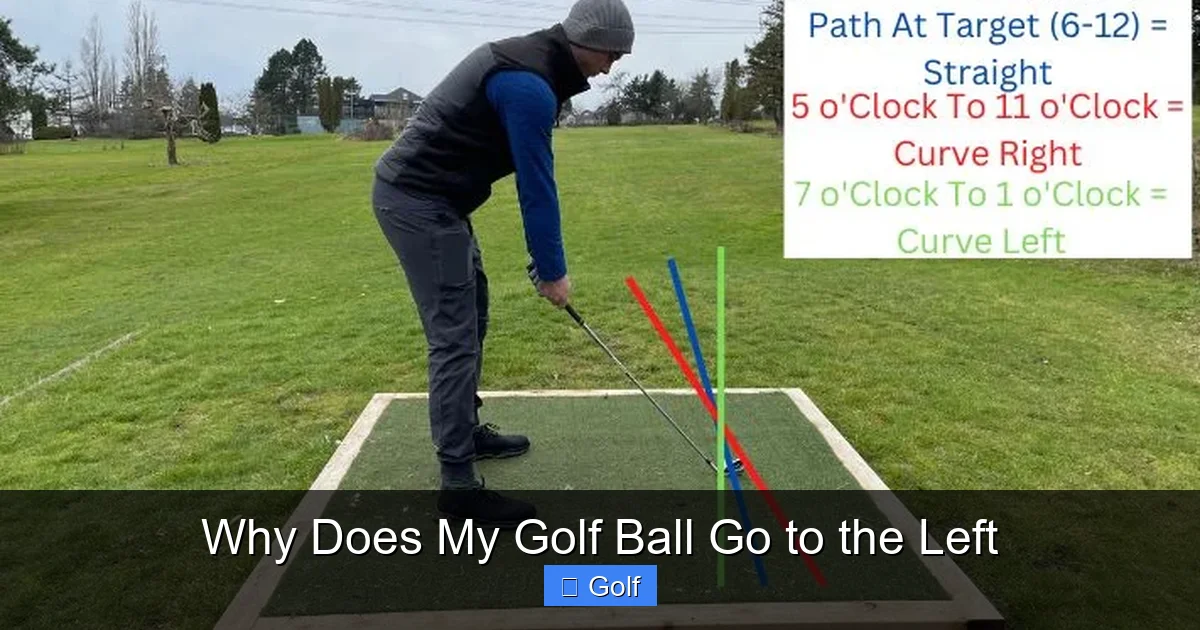
Visual guide about Why Does My Golf Ball Go to the Left
Image source: outofboundsgolf.com
Identifying a Strong Grip
Look down at your left hand when you address the ball. If you can see three or four knuckles, your grip is likely quite strong. While some professionals play with a strong grip, they have the timing to square the face at the last millisecond. For the average weekend golfer, this position makes it very easy to flip the hands over at impact, causing the clubface to shut down and send the ball scurrying left.
Adjusting for Success
Try to move your left hand back to a neutral position where you only see two knuckles. This small change can prevent the clubface from slamming shut during your downswing. It might feel uncomfortable for the first few holes, but once you get used to it, you will find it much easier to keep the face square through the impact zone.
The Curse of Early Extension
Early extension happens when your hips move toward the ball during the downswing instead of rotating around your spine. When your body moves toward the ball, you lose the space required to swing the club freely. To avoid hitting your own body, your hands and arms have to manipulate the club. This usually results in an “in-to-out” swing that shuts the face, leading to a ball that starts right and hooks hard, or a block-hook.
Staying in Your Posture
To fix early extension, focus on maintaining your spine angle throughout the swing. Imagine there is a wall behind you. During your backswing and downswing, your right glute (for a right-handed player) should stay in contact with that imaginary wall. If you push away from the wall, your body is moving forward, and your hands will be forced to compensate.
Drills to Stay Back
A great way to practice this is to place an empty golf bag or a chair behind you while you swing. If you move toward the ball, you will bump into the object. By staying clear of the object, you train your body to rotate around your center, which allows the club to square up naturally rather than forcing it with your hands.
Alignment and Aim
Sometimes, we look for complicated mechanical reasons why the golf ball goes to the left, only to realize that we are aimed at the left rough. If your feet, hips, and shoulders are all pointed to the left of your target, your body is naturally going to try to swing along that line. If your swing is consistent, your ball will follow your body’s orientation.
The Train Track Method
Always practice with alignment sticks or two golf clubs on the ground. One club should be on your target line, and the other should be parallel to your feet. Most golfers who struggle with leftward shots are aiming their feet and shoulders much further left than they realize. Correcting your alignment is the easiest “fix” in the game and requires no change to your actual swing.
Don’t Over-Compensate
If you keep hitting the ball left, your instinct will be to aim further right. This is a mistake. Aiming right will only force you to swing even more aggressively from the inside-out, which can cause even more hooking. Get your alignment neutral first, then address the swing path issues. Once you are aligned correctly, you can see if your ball flight is actually problematic or if your eyes were simply playing tricks on you.
Equipment Considerations
Technology in 2026 is amazing, but it can also expose flaws in your equipment. If you are playing with a driver or irons that have shafts that are too soft or flexible for your swing speed, the clubhead will lag behind your hands. As the shaft “kicks” through the impact zone, it can close the clubface aggressively.
Check Your Flex
If your swing speed is above average, you need a stiffer shaft. A shaft that is too flexible acts like a whip; if it whips too hard, it closes the face before you reach the ball. Visit a local pro shop and have a launch monitor session to ensure your current equipment matches your swing speed and tempo.
Lie Angle Adjustments
Another equipment factor is the lie angle of your clubs. If your irons are too “upright,” the toe of the club will be pointing slightly up at impact. This pushes the toe of the club into the ground and closes the face relative to the path. A quick fitting can determine if your clubs need to be bent flatter, which is a common adjustment that helps many golfers stop pulling the ball.
Conclusion: The Path to Straighter Shots
Asking yourself, “why does my golf ball go to the left,” is the first step toward improving your game. By examining your grip, your body movement, and your equipment, you can move away from the frustration of wayward shots and toward the joy of finding the fairway. Remember that golf is a game of patience and small adjustments.
Do not try to fix everything at once. Pick one area perhaps your grip or your alignment and work on it for a few practice sessions. Once you see the ball flight start to neutralize, you will gain the confidence to make the next adjustment. Keep your swing simple, trust your process, and enjoy the game. With these tips in mind, you will spend much less time in the trees and much more time lining up for your next birdie putt in 2026.
FAQs
Why does my ball start left and then curve further left?
This is usually a pull-hook. Your clubface is closed at impact, and your swing path is moving from the outside in, which puts side-spin on the ball causing it to travel sharply to the left.
Can a bad grip really make me hit the ball left?
Yes, absolutely. A grip that is too strong rotates your hands into a position that naturally shuts the clubface during the downswing, making it very difficult to strike the ball squarely.
Is it better to change my swing or my equipment?
Always work on your swing mechanics first. Equipment changes can help, but if your fundamentals—like your grip and alignment—are flawed, a new club will not solve the underlying issue.
How does early extension lead to shots going left?
When you lunge toward the ball, you lose space and are forced to flip your hands at the last second to avoid missing the ball entirely. This flip usually closes the clubface significantly, causing the ball to go left.
What is the easiest way to test if I am aimed left?
Use an alignment stick on the ground during your practice sessions. It is the most effective way to see if your body is parallel to your target line, as human perception often makes us aim left when we think we are aiming straight.
Should I swing differently if I am hitting it too far left?
Instead of changing your swing consciously, focus on a swing thought that emphasizes an “in-to-out” path or a more neutral face. Over-compensating by “steering” the ball will usually lead to worse results and inconsistent contact.
Frequently Asked Questions
What is why does my golf ball go to the left?
why does my golf ball go to the left is an important topic with many practical applications.