
Whats the Difference Between Mens and Womens Golf Clubs?
Understanding the technical differences between mens and womens golf clubs is essential for maximizing your performance on the course. While manufacturers design these clubs to cater to varying average swing speeds and physical statures, the best choice always depends on your unique swing profile rather than just your gender.
Walking into a golf shop in 2026 can feel a bit overwhelming. You see walls lined with shiny, high-tech gear, all promising to add yards to your drive and precision to your approach shots. One of the most common questions golfers ask is: what is the actual difference between mens and womens golf clubs? Is it just the color, or is there science behind the labels?
The truth is that golf equipment manufacturers engineer these clubs based on physical averages. While it might seem like a simple split between gender lines, it is really about physics. By understanding how these design choices work, you can stop guessing and start playing with equipment that truly matches your unique swing.
Key Takeaways
- Shaft Flexibility: Womens golf clubs typically feature more flexible shafts to help players with slower swing speeds achieve better distance and launch.
- Club Weight: Womens clubs are generally lighter, which allows for easier handling and increased swing speed for those who need it.
- Club Length: Mens golf clubs are usually longer because they are engineered for the average height and arm span of the male demographic.
- Grip Size: Womens clubs feature thinner grips to accommodate smaller hand sizes, ensuring a more secure and comfortable hold.
- Loft Angles: Womens drivers and woods often have higher loft angles to compensate for lower swing speeds, helping the ball stay in the air longer.
- Performance Over Labels: Your swing speed, tempo, and physical build are more important metrics than the gender label on the club set.
The Physics of Shaft Flex and Swing Speed
The shaft is the engine of your golf club. If you have ever felt like you are fighting your equipment, the shaft is usually the culprit. In the context of mens and womens golf clubs, flexibility is the primary differentiator.
Why Flexibility Matters
Most womens golf clubs come with L-flex (Ladies) shafts, which are highly flexible. Mens clubs usually start at R-flex (Regular) or S-flex (Stiff). A more flexible shaft “bends” more during the downswing. This bending action helps the clubhead snap back into a square position at impact. If you have a slower swing speed, a flexible shaft helps you “load” the club, effectively acting like a slingshot to generate more power.
Matching the Shaft to You
If a player with a fast swing uses an overly flexible shaft, the clubhead may not return to the correct position, leading to hooks or slices. Conversely, if a player with a slower swing uses a stiff shaft, they might struggle to get the ball into the air. Think of it like a diving board; you need the right amount of spring for your weight and speed.
Weight and Length Considerations
Golf is a game of repetition. If your clubs are too heavy or too long, your muscles will fatigue quickly, leading to poor form in the later holes of your round. When we compare mens and womens golf clubs, mass and geometry play a massive role.
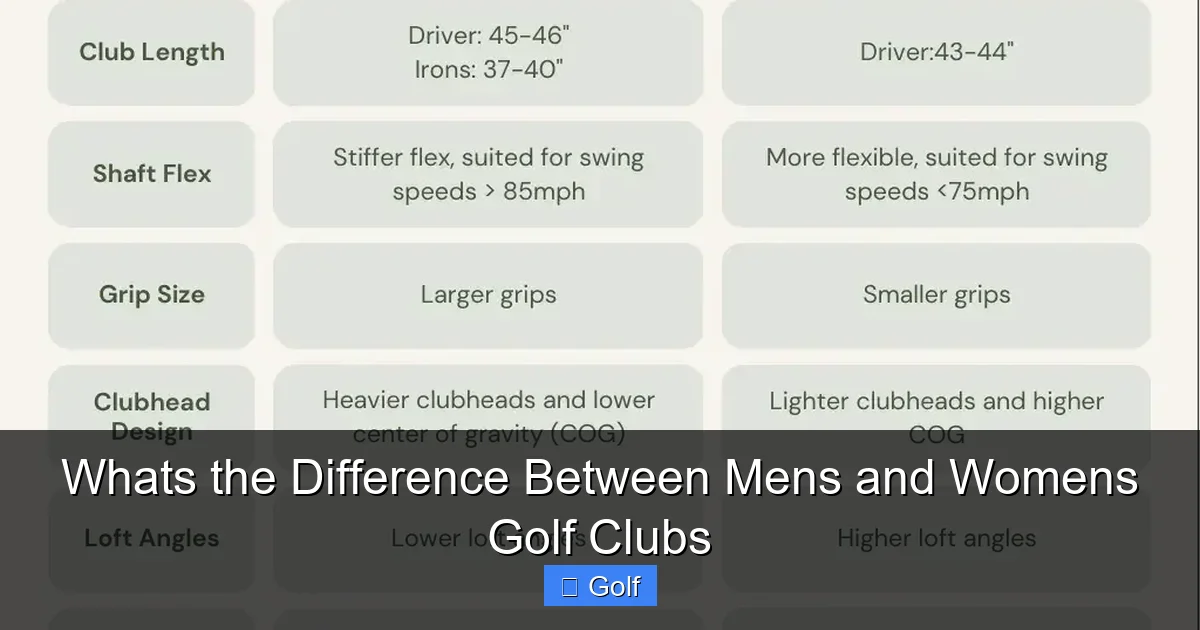
Visual guide about Whats the Difference Between Mens and Womens Golf Clubs
Image source: foreputtgolf.com
The Weight Advantage
Womens golf clubs are almost always lighter than their male counterparts. This weight reduction isn’t just for comfort; it is for speed. A lighter club is easier to accelerate.
If you are a beginner or someone who struggles to maintain a consistent rhythm, a lighter club can help you swing with more freedom. Many men who are starting out actually find that womens or “senior” flex clubs feel much more natural and forgiving while they learn the basics.
Geometry and Height
Length is perhaps the most practical difference. Because the average man is taller than the average woman, mens clubs are generally longer. However, height is a personal trait. A tall woman might find that a standard womens set is far too short, causing her to hunch over the ball. Always prioritize your height and wrist-to-floor measurement over the gender branding on the box.
Grip Size and Your Connection to the Club
The grip is the only part of the club you actually touch. If your grip size is wrong, your ability to control the club face is severely compromised. This is a subtle but vital part of the difference between mens and womens golf clubs.
The Impact of Grip Diameter
Womens golf clubs feature thinner grips. This is designed for smaller hand sizes. If a grip is too thick, you lose “feel” and have to squeeze too hard, which tenses up your forearms and kills your swing fluidity. If a grip is too thin, you might experience too much hand movement, causing the club to twist at impact.
Testing Your Fit
A quick tip for 2026 golfers: visit a shop and hold a few different clubs. If your fingers are digging into your palm when you grip, the handle is too thin. If there is a huge gap, it is too thick. You can always have your local pro shop regrip your clubs to your exact hand size, regardless of whether you bought a mens or womens set.
Loft and Launch Dynamics
Have you ever wondered why womens drivers often have higher loft numbers? It is all about maximizing your flight. The loft is the angle of the club face, and it is the main factor in how high the ball launches.
Increasing the Launch
For golfers with lower swing speeds, getting the ball in the air is often the biggest challenge. Higher loft angles on womens clubs—such as a 13-degree driver compared to a 9-degree mens version—create more backspin and lift. This helps the ball stay in the air longer, which inevitably leads to more distance for those who are not hitting the ball at high speeds.
Forgiveness and Center of Gravity
Manufacturers often push the center of gravity further back in womens club heads. This makes the club more forgiving. If you hit the ball toward the bottom of the face, a low center of gravity helps launch it upward, preventing those frustrating “worm burners” that roll along the ground.
Dispelling the “Gendered” Equipment Myth
In 2026, the industry is moving toward a more inclusive approach. The best golfers are those who use equipment that matches their physical output, not their social label. We are seeing more “unisex” options and customizable fitting experiences that ignore gender entirely.
Focus on Swing Metrics
If you have access to a launch monitor, look at your ball speed and swing speed. If you are a man with a lower swing speed, you will likely perform significantly better with lightweight, high-loft, flexible-shaft clubs, even if they are marketed as “womens.” Conversely, an athletic woman with a high swing speed might find a mens stiff-shaft club gives her the control she craves.
Custom Fitting is Key
The best advice for any golfer is to get a professional club fitting. A professional will measure your launch angle, spin rate, and carry distance. They don’t care what the label says; they care about what the numbers say. In the long run, investing in a fitting will save you more money than buying a generic set off the shelf, because you will be buying the right gear the first time.
Practical Tips for Your Next Purchase
So, you are ready to update your bag. How do you apply this information? Start by being honest about your game. Don’t buy a club because your favorite pro uses it. Buy the club that makes you feel confident and comfortable.
- Test before you buy: Never buy a full set without hitting them in a bay.
- Check the flex: If your ball is slicing right consistently, your shaft might be too flexible. If it is hooking left, it might be too stiff.
- Consider the weight: Can you swing the club 50 times without feeling exhausted? If not, look for lighter components.
- Don’t ignore the grips: You can change the grips on any club for very little money. This is an easy way to customize a set to your needs.
In conclusion, the differences between mens and womens golf clubs are rooted in the pursuit of efficiency. While these categories serve as a helpful starting point for the average consumer, they should never be treated as rules.
Your swing is as unique as your fingerprint. By focusing on your personal swing speed, physical build, and comfort, you can select the perfect set of clubs to help you lower your score and enjoy every round you play in 2026 and beyond.
Frequently Asked Questions
Do I have to use golf clubs designed for my gender?
Absolutely not! You should choose clubs based on your swing speed, height, and physical strength rather than the label on the box. Many players find success mixing and matching components from both categories.
Can I shorten mens golf clubs to fit me?
You can, but it changes the swing weight and balance of the club. It is usually better to get a professional fitting to see if a custom set or a different flex would be a better long-term solution.
What is the most important factor in choosing a golf club?
The most important factor is the shaft flex, as it needs to match your swing speed to deliver the clubhead squarely at impact. If the shaft is wrong for your speed, it will be difficult to hit consistent shots regardless of the clubhead.
Why do womens clubs have more loft?
The higher loft on womens clubs helps golfers with slower swing speeds generate more lift and carry distance. By getting the ball in the air more effectively, players can achieve a better overall ball flight.
Are grips interchangeable between mens and womens clubs?
Yes, grips are universal in terms of installation. If you find a club that performs perfectly but the grip feels off, you can easily replace it with a size and texture that suits your hands.
How often should I re-evaluate my golf equipment?
You should assess your equipment whenever your game changes significantly, such as after taking lessons or if you notice a consistent miss in your shots. Even for recreational golfers, a check-up every two to three years is a good habit.